
The Anglo–Asante Wars (1824–1901)

How the Gold Coast Became a Centre of Human Trafficking
Introduction
Photo Header: British Fort Anamabo. Article by Remo Kurka - The Anglo–Asante Wars were among the most significant military conflicts in West African history. Fought between the powerful Asante Kingdom and the expanding British Empire during the nineteenth century, these wars determined who would control the Gold Coast and profoundly influenced the political development of modern Ghana.
For nearly eighty years, the Asante successfully resisted one of the world's most powerful empires. Their disciplined armies, experienced commanders, and sophisticated political organisation enabled them to defeat numerous opponents and establish one of Africa's most formidable states. Britain, meanwhile, sought to protect its commercial interests along the coast, secure access to inland trade routes, and eventually establish complete colonial authority over the region.
The struggle was not simply a clash between Britain and Asante. It also involved coastal African states, especially the Fante Confederation, neighbouring kingdoms, and shifting alliances that reflected the complex political landscape of nineteenth-century West Africa.
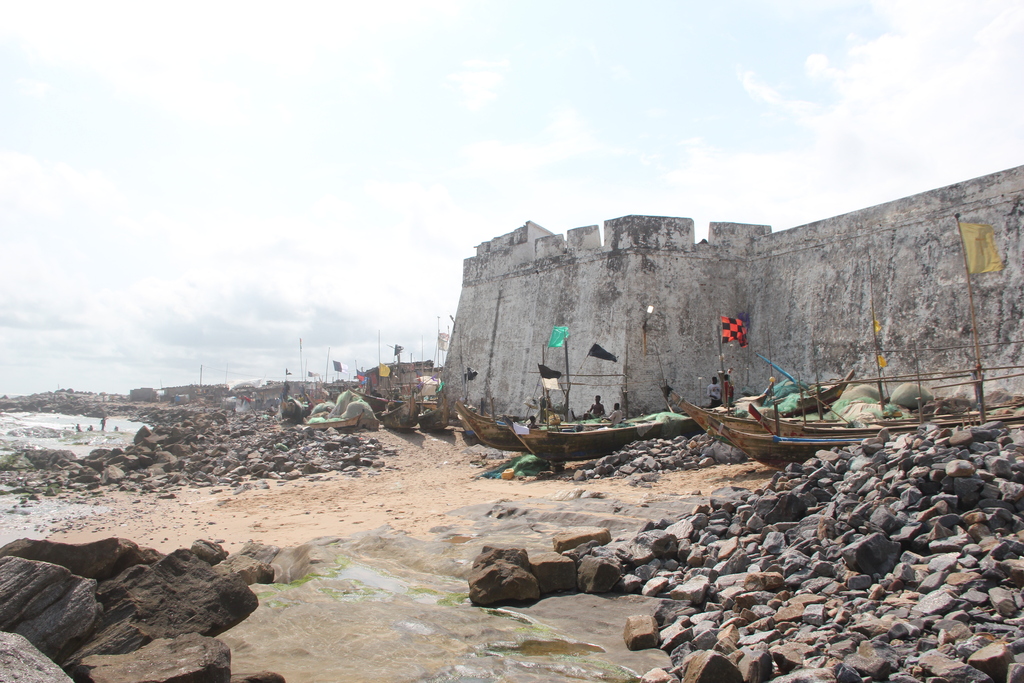
Photo of Anamabo Fort, seen from the beach, fishing boats, Ghana (c) documented by Remo Kurka
The Rise of the Asante Kingdom
The origins of the Anglo–Asante Wars lie in the remarkable rise of the Asante Kingdom during the late seventeenth and eighteenth centuries.
Under the leadership of Osei Tutu I and his chief priest and adviser Okomfo Anokye, several Akan-speaking states united to form the Asante Confederacy. According to tradition, the Golden Stool descended from the heavens as the spiritual symbol of Asante unity and nationhood.
From its capital at Kumasi, the Asante Kingdom expanded rapidly through diplomacy, military campaigns, and strategic alliances. By the late eighteenth century, Asante controlled much of central Ghana and dominated important trade routes carrying gold, kola nuts, and other valuable commodities between the forest regions and the coast.
This expansion inevitably brought the kingdom into conflict with neighbouring states, including the Fante Confederation.
The Fante Confederation and British Alliance
Along the Atlantic coast, the Fante states had developed close commercial relationships with European traders for centuries.
Unlike the inland Asante, the Fante controlled many of the routes leading to European forts and castles, including Cape Coast Castle and Anomabu Fort. Their prosperity depended heavily on coastal trade with Britain and other European powers.
As Asante influence expanded southward, the Fante increasingly viewed Britain as a valuable ally. British officials likewise recognised that maintaining friendly relations with the Fante helped protect coastal trade and safeguarded Britain's forts and commercial interests.
This alliance would eventually draw Britain into direct conflict with the Asante Kingdom.
The Battle of Anomabu and the Ashanti–Fante War (1806–1807)
Although the formal Anglo–Asante Wars began in 1824, the events of 1806–1807 marked an important turning point.
During the Ashanti–Fante War, tensions escalated after disputes involving the Assin people, who had traditionally occupied territory between the Asante heartland and the Fante coast. Several Assin chiefs, facing military pressure from the Asante, fled south and sought protection among the British and their Fante allies.
The Asante demanded that two of these leaders be surrendered. The British authorities at Anamabo refused, arguing that those under their protection would not be handed over.
This refusal transformed what had been a regional dispute into a wider political confrontation.
Asante forces advanced toward the coast, defeating the Fante in several engagements despite the latter's longstanding commercial partnership with Britain. One of the most significant confrontations occurred around Anomabu, where British officials attempted to support their coastal allies. The Asante army were victorious and captured the fort even!
Although British forts themselves remained secure, the Fante coalition suffered major defeats, demonstrating the military effectiveness of the Asante army. The campaign exposed the limitations of Britain's military presence on the Gold Coast and showed that the Asante remained the dominant power inland.
The conflict also established a pattern that would define the next century: Britain increasingly found itself drawn into wars that initially arose from disputes among African states and competing regional interests.
Why Britain and Asante Went to War
Several factors fuelled the Anglo–Asante Wars.
Control of Trade
Both Britain and the Asante Kingdom wanted access to profitable trade routes connecting the interior with the Atlantic coast. Gold remained an important commodity, while other exports—including timber, palm oil, ivory, and later cocoa—made the region increasingly valuable.
Political Influence
Britain sought to expand its authority over the coastal settlements, while the Asante aimed to preserve its influence over neighbouring states and maintain control of tribute-paying territories.
Protection of Allies
The British increasingly considered the Fante states and other coastal communities to be under their protection. Meanwhile, the Asante regarded many inland states, including the Assin, as subject peoples whose affairs should not be influenced by British officials.
These conflicting views repeatedly brought the two powers into confrontation.
The First Anglo–Asante War (1823–1831)
The immediate cause of the first formal war again involved the Assin.
After several Assin leaders sought British protection following conflict with the Asante, British officials refused Asante demands to surrender them. Tensions escalated rapidly.
In 1824, Governor Sir Charles MacCarthy led British forces against the Asante but underestimated their strength.
At the Battle of Nsamankow, MacCarthy's force was overwhelmed. The governor was killed, and his defeat shocked Britain.
The Asante advanced toward the coast, but British reinforcements, improved logistics, and support from coastal allies eventually prevented further major Asante advances.
Although neither side achieved complete victory, Britain realised that defeating the Asante would require significantly greater military resources.
The Second Anglo–Asante War (1863–1864)
The second conflict began after renewed border disputes and disagreements over jurisdiction in territories between the coast and the Asante heartland.
Disease proved as dangerous as combat.
British troops suffered heavily from malaria and other tropical illnesses, while military operations became increasingly difficult.
The campaign ended without a decisive outcome, leaving many underlying tensions unresolved.
The Sagrenti War (1873–1874)
The best-known conflict was the Third Anglo–Asante War, remembered in Ghana as the Sagrenti War.
The name "Sagrenti" is widely believed to be a local pronunciation of Sir Garnet Wolseley, the British general who commanded the expedition.
By this time Britain possessed significant technological advantages.
The expedition included modern rifles, artillery, organised engineering units, improved medical services, and better transport systems. Roads were constructed through dense forests, allowing British forces to advance more effectively than in earlier campaigns.
Despite determined Asante resistance, British forces captured Kumasi in February 1874.
Rather than occupying the city permanently, they burned large sections of the royal capital before withdrawing.
The subsequent Treaty of Fomena forced the Asante Kingdom to recognise the independence of several neighbouring states and weakened its regional influence.
Although not destroyed, the kingdom emerged considerably diminished.
The Fourth Anglo–Asante War (1895–1896)
By the 1890s Britain sought complete political control over the Gold Coast.
A large British expedition marched toward Kumasi with overwhelming military superiority.
Recognising the imbalance of forces and hoping to avoid unnecessary destruction, Asantehene Prempeh I chose not to engage in major military resistance.
He was arrested and later exiled, first to Sierra Leone and subsequently to the Seychelles.
Britain effectively took control of the kingdom, although resistance continued.
The War of the Golden Stool (1900)
Although often treated separately from the Anglo–Asante Wars, the War of the Golden Stool became the final major act of Asante resistance.
British Governor Sir Frederick Hodgson demanded to sit upon the sacred Golden Stool—a request viewed by the Asante as profoundly offensive because the stool symbolised the soul of the nation rather than merely political authority.
The resulting uprising was led by the remarkable Yaa Asantewaa, Queen Mother of Ejisu.
She organised one of the most famous resistance movements in African colonial history, rallying Asante forces to defend their sovereignty and sacred traditions.
Although British reinforcements eventually suppressed the rebellion, Yaa Asantewaa became one of Ghana's greatest national heroes.
The Annexation of Asante (1901)
Following the suppression of the uprising, Britain formally annexed the Asante Kingdom in 1901.
The kingdom became part of the British Gold Coast Colony, ending centuries of Asante independence.
Although traditional institutions survived under colonial administration, ultimate political authority now rested with the British government.
This marked the completion of Britain's consolidation of power across much of present-day Ghana.
Legacy of the Anglo–Asante Wars
The Anglo–Asante Wars transformed West Africa.
For Britain, victory secured access to valuable resources, expanded imperial influence, and strengthened control over one of its most important West African colonies.
For the Asante, the wars represented the determined defence of political independence, cultural identity, and national sovereignty against imperial expansion.
The conflicts also reshaped relationships between inland kingdoms and coastal states, particularly the Fante Confederation, whose alliance with Britain had profound consequences for the political future of the Gold Coast.
Today, historians increasingly recognise these wars not simply as colonial campaigns but as contests between two highly organised political powers pursuing competing visions for the future of the region.
Yaa Asantewaa
The Anglo–Asante Wars were not inevitable. They emerged from decades of changing alliances, commercial competition, and regional politics that included the earlier Ashanti–Fante War of 1806–1807 and disputes over the protection of the Assin chiefs. What began as conflicts between African states gradually drew Britain into a prolonged struggle with one of Africa's strongest kingdoms.
Despite Britain's eventual victory, the Asante Kingdom demonstrated extraordinary military resilience and political organisation throughout nearly eighty years of resistance. Leaders such as Osei Tutu I, Prempeh I, and Yaa Asantewaa remain enduring symbols of Ghanaian history, while the wars themselves played a decisive role in shaping the boundaries, governance, and colonial experience that ultimately influenced Ghana's path to independence in 1957.