
British Colonial Administration & the Making of Modern Ghana (1901–1957)

British Colonial Administration & the Making of Modern Ghana
Introduction
Photo Header: Cape Coast (Oguaa) and Cape Coast Castle. Article by Remo Kurka -
When Britain formally annexed the Asante Kingdom in 1901, it marked the beginning of a new chapter in the history of the Gold Coast. After nearly a century of military conflict, diplomatic negotiations, and gradual territorial expansion, Britain had established control over almost all of present-day Ghana.
Colonial administration transformed nearly every aspect of life. New laws were introduced, roads and railways were constructed, schools and hospitals expanded, and English became the language of government and education. At the same time, colonial policies redirected the economy to serve British interests, altered traditional systems of authority, imposed taxes, and restricted the political independence of African communities.
Many of the institutions created during this period—including Ghana's civil service, judicial system, parliamentary traditions, educational framework, and national infrastructure—continue to influence the country today. Understanding British colonial administration is therefore essential to understanding the making of modern Ghana.
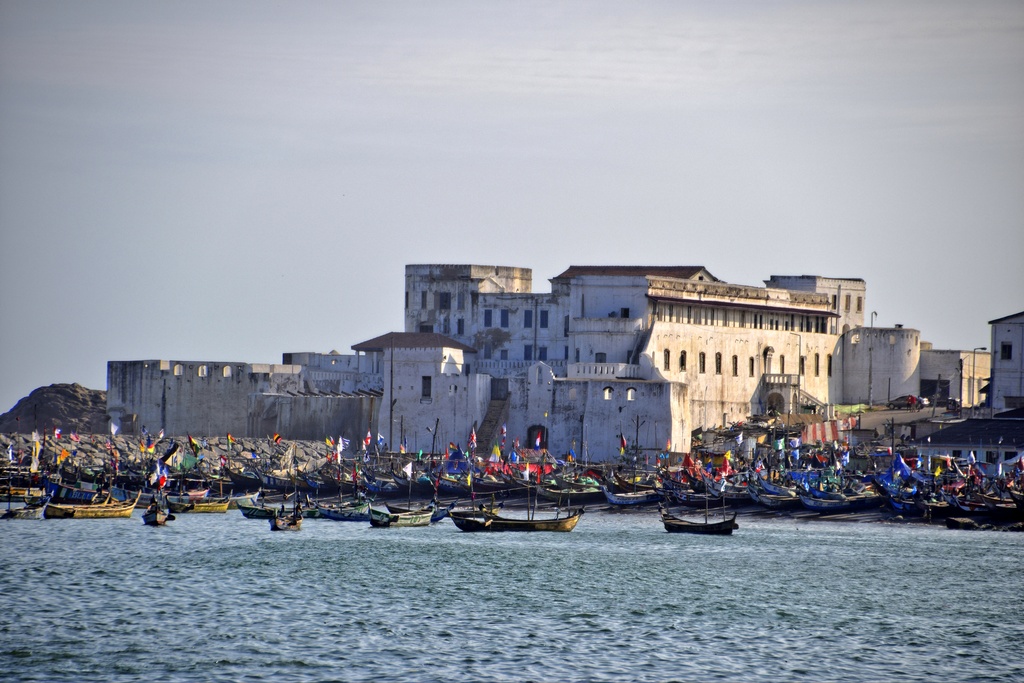
Photo of Cape Coast Castle, the beach, fishing boats, Ghana (c) documented by Remo Kurka
From British Influence to Formal Colonial Rule
Britain’s relationship with the Gold Coast began centuries earlier through coastal trade, fortified settlements, and diplomatic agreements with African states. For much of this early period, British influence was concentrated along the coastline, while powerful inland kingdoms maintained their independence.
The most important of these inland powers was the Asante Kingdom, which controlled major trade routes and possessed a highly organised political and military system.
During the nineteenth century, repeated conflicts between Britain and Asante gradually weakened Asante influence. Following the final Anglo–Asante conflicts and the exile of Asantehene Prempeh I in 1896, Britain moved toward direct control. In 1901, Asante was formally annexed, completing Britain's expansion into the interior.
The British-controlled territories were divided into different administrative areas:
- The Gold Coast Colony along the coast.
- The Ashanti Territory.
- The Northern Territories Protectorate.
- British Togoland, which came under British administration after the First World War.
Together, these territories eventually formed the boundaries of independent Ghana in 1957.
The Structure of British Colonial Administration
The Gold Coast was governed by a British Governor appointed by the Crown. The Governor held extensive executive powers and supervised colonial departments responsible for finance, justice, education, agriculture, public works, health, and security.
Colonial officials were placed throughout the territory to manage districts and provinces. Their responsibilities included collecting taxes, enforcing laws, supervising economic activities, and maintaining British authority.
Although advisory councils existed, real political power remained in British hands for most of the colonial period. African representation increased gradually, but decision-making remained controlled by colonial officials.
This centralised administrative system later influenced Ghana’s own governmental structures after independence.
Indirect Rule and Traditional Authorities
One of the most important features of British colonial government was the policy of indirect rule.
Rather than replacing traditional leaders entirely, Britain governed through selected chiefs and traditional authorities. Chiefs were incorporated into the colonial system and were given responsibilities such as maintaining local order, settling customary disputes, collecting taxes, and implementing government policies.
This approach allowed Britain to govern a large territory with relatively few European officials.
However, indirect rule also changed traditional political structures. In some cases, colonial administrators recognised chiefs who supported British interests, even when their local authority was disputed. Traditional leaders who had previously operated within complex systems of consultation and accountability increasingly became representatives of colonial power.
The effects of this system continued to influence Ghana’s relationship between traditional leadership and modern government.
The Colonial Legal System
British rule introduced a formal legal system based largely on English common law.
Colonial courts handled criminal cases, commercial disputes, taxation matters, and issues involving colonial regulations. At the same time, traditional courts continued to deal with aspects of customary law, including inheritance, marriage, family matters, and land disputes.
This created a dual legal system combining British law with African customary practices.
Modern Ghana continues to reflect this historical combination, with customary law recognised alongside the national legal framework.
Taxation and Colonial Revenue
Taxation became a central part of British administration.
The colonial government required revenue to operate its institutions, maintain security forces, and develop infrastructure. Taxes were collected through various systems, including customs duties, export taxes, licences, and direct taxation.
Much of the revenue generated came from Ghana’s natural resources and agricultural exports, particularly cocoa, gold, timber, and minerals.
While taxation helped finance public projects, many Africans viewed colonial taxes as unfair because they were imposed without meaningful political representation. Resistance to taxation became one of the factors contributing to growing political awareness and nationalist movements.
Infrastructure and Economic Development
British administration introduced major infrastructure projects that reshaped the Gold Coast.
Railways connected farming and mining regions with coastal ports, allowing goods to move more efficiently for export. Roads expanded connections between communities, including the 1930 Beposo Suspension Bridge, while harbour improvements supported international trade.
The development of Takoradi Harbour in 1928 became particularly important, providing a modern export facility for cocoa, minerals, and other resources.
Communication networks, including postal services and telegraph lines, also expanded during the colonial period.
However, infrastructure development was primarily designed to support the colonial economy. Roads and railways were often built to transport raw materials from production areas to ports rather than to encourage balanced internal development.
The Cocoa Economy and Natural Resources
Cocoa became the foundation of the Gold Coast economy during British rule.
The crop was introduced through African initiative rather than colonial planning, with Ghanaian farmer Tetteh Quarshie playing a key role in its early development. By the twentieth century, the Gold Coast had become one of the world’s leading cocoa producers.
Cocoa farming created new opportunities for African farmers and traders, helping to establish an economically influential middle class.
At the same time, Britain benefited greatly from export duties and international trade connected to cocoa production.
The colony’s other resources—including gold, diamonds, manganese, timber, and bauxite—also attracted foreign investment. Mining expanded under British companies, but much of the financial benefit flowed overseas rather than remaining within local communities.
Missionary Education and the Rise of an Educated Elite
Education was one of the most influential areas of colonial transformation.
Christian missionary organisations established schools throughout the Gold Coast, teaching literacy, mathematics, English, and religious studies. Over time, the colonial government also expanded educational institutions.
Schools produced a new generation of African professionals, including teachers, lawyers, doctors, journalists, civil servants, and political leaders.
Institutions such as Mfantsipim School, Wesley Girls’ High School, Achimota School, and the University College of the Gold Coast played important roles in shaping Ghana’s educated elite.
Ironically, the education system introduced during colonial rule also created many of the leaders who later challenged British authority and demanded independence.
Healthcare and Social Change
British administration expanded healthcare services through hospitals, clinics, vaccination programmes, and public health campaigns.
Medical facilities helped address diseases such as smallpox and improved responses to health challenges affecting both African communities and European officials.
However, access to healthcare remained uneven, with rural communities often receiving fewer services than urban centres.
Despite these limitations, colonial healthcare systems formed part of the foundation for Ghana’s later national health institutions.
The Growth of Nationalism
As education expanded, a politically aware African population began demanding greater participation in government.
Teachers, lawyers, journalists, and business leaders criticised colonial policies and called for increased African representation.
Organisations such as the Aborigines’ Rights Protection Society challenged colonial land policies, while newspapers promoted political discussion and African self-determination.
After the Second World War, nationalist movements grew rapidly. African soldiers who had fought alongside British forces returned home expecting greater equality and political rights.
The United Gold Coast Convention (UGCC) and later Kwame Nkrumah’s Convention People’s Party (CPP) transformed the independence movement into a mass political campaign.
The Road to Independence
Britain gradually introduced constitutional reforms that increased African participation in government.
The Coussey Constitution of 1951 expanded elected representation, while later reforms transferred more authority to African ministers.
The Convention People’s Party gained widespread public support by campaigning for immediate independence. Following electoral victories, the Gold Coast moved steadily toward self-government.
On 6 March 1957, the Gold Coast became the independent nation of Ghana, becoming the first sub-Saharan African colony to achieve independence from Britain in the modern era.
Kwame Nkrumah became Ghana’s first Prime Minister and later its first President, leading the country into a new chapter of African self-government.
The Legacy of British Colonial Administration
British colonial rule left a complicated legacy.
Among the lasting institutions inherited from the colonial period are:
- Central government administration.
- English as the official language.
- Parliamentary traditions.
- The modern legal system.
- National education structures.
- Transport and communication networks.
- International trade connections.
At the same time, colonial rule created challenges that continued after independence, including economic dependence on raw material exports, regional inequalities, and the legacy of centralised authority.
Modern Ghana has continued to develop and adapt these inherited systems while addressing the inequalities created during the colonial era.
Independence March 6, 1957
British colonial administration played a defining role in shaping the political and social foundations of modern Ghana. The creation of government institutions, legal systems, educational networks, and infrastructure influenced the development of the country that emerged at independence in 1957.
However, colonial rule was also a system of foreign control designed primarily to serve British economic and strategic interests. The transformation of the Gold Coast came with significant costs, including the weakening of traditional authority, exploitation of natural resources, and limited political participation for Africans.
The history of British administration in Ghana is therefore one of both institutional development and colonial domination. Understanding this complex legacy helps explain the structures, opportunities, and challenges that continue to shape Ghana today.